Accompanies Beef Grading Quality Worksheet Answers
Meat Inspection and Grading
- Jump To:
- What is meat and Poultry Inspection?
- The Difference Between state and Federal Inspection
- Marks of Wholesomeness
- Inspection Process
- Inspection at Retail Level
- The Difference Between Meat Inspection and Meat Grading
- Summary
Too many times consumers accept things for granted well-nigh their food products. Meat inspection and grading are those activities related to meat products that are of import in assuring the best product in the world for the consumer. The purpose of this fact sheet is to broaden your noesis of meat inspection and grading and reinforce your confidence in the wholesome meat products you are buying.
What is meat and Poultry Inspection?
Meat inspection assures the consumer that the meat and poultry products are clean, condom, and wholesome for human consumption at the time of purchase. This involves inspection of the live fauna, carcass, internal organs, plant facilities, equipment, personnel, and transportation system.
Meat inspection became law under the Federal Meat Inspection Act of 1906. It required inspection of cerise meat products sold in interstate and foreign commerce. The Act established strict sanitation requirements for plants and chosen for examination of all labels for truthfulness and accurateness. In 1967, the Federal Meat Inspection Act was amended with the Wholesome Meat Deed. This amendment established the Federal-Land Cooperative inspection programme, which required State Inspection programs to be "at least equal to" the Federal inspection program. The 1968 Wholesome Poultry Products Acts extended the same provisions to poultry inspection. In Oklahoma, nosotros have both Land and Federal inspection services available.
The Difference Between state and Federal Inspection
As previously mentioned, both programs are basically the same. The difference relates to limitations of sales and distribution on the country inspected performance and to who administers the services.
Commencement, the Federal Meat and Poultry Inspection Programme is administered past the U.South. Department of Agriculture's Nutrient Prophylactic and Inspection Service (FSIS). The organizational structure of FSIS consists of a slaughter inspection sectionalisation, a processed meat inspection segmentation, a technical services, and a compliance and evaluation staff. Each sectionalisation has defined responsibilities in monitoring meat and poultry products for wholesomeness and labeling accurateness.
Meat inspectors are divided into ii classes: (ane) veterinary inspectors and (ii) lay inspectors. In both cases, they are employed and paid past the U.S. government and not past the individual processors. The veterinary inspectors are college trained veterinarians, while the lay inspectors are individuals who have grooming and experience in handling meat. The lay inspectors are under the direction of a veterinary inspector.
The same organizational structure exists in a country inspection program. The Oklahoma state inspection division is under the direction of the Oklahoma State Department of Agriculture. The cost of operating the inspection sectionalisation is budgeted through state appropriations. The State Inspection Plan is subject to a Federal review to certify that it is equal to federal inspection.
The major difference between Federal inspection and state inspection is the restriction that country inspected plants are nether in distributing their products. Meat that receives Oklahoma country inspection must be used and sold inside the state. It cannot exist shipped out of the state of Oklahoma. Federally inspected products may be sold or shipped across state lines or exported to foreign countries.
Marks of Wholesomeness
Inspection stamps are the consumer'due south assurance that a product is wholesome and accurately labeled. The establish where the product was slaughtered or produced is identified by the number on the inspection stamp.
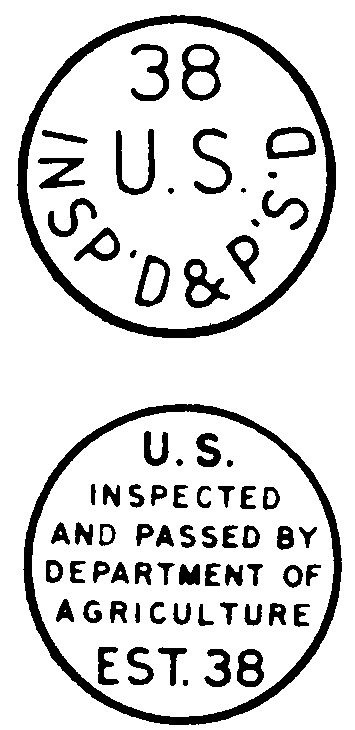
Above: This is the official USDA mark for canonical meat carcasses. Information technology is stamped but on major cuts of the carcass, so information technology may not e'er be visible on consumer cuts like roasts and steaks. The blue ink used for branding of fresh meat is a nutrient grade dye and safety for consumption.
BELOW: This mark is on all federally inspected pre-packaged processed meat products from vacuum-packed beef brisket to frankfurters.
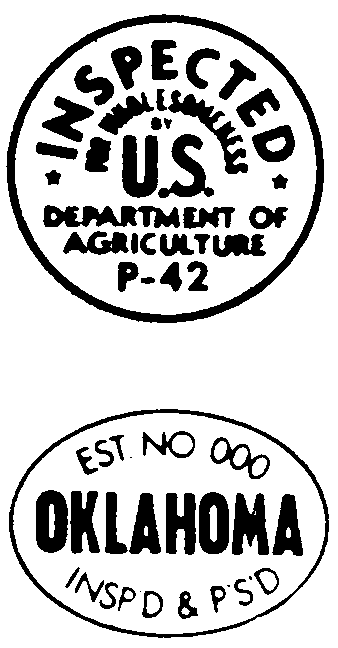
ABOVE: Federally inspected fresh and frozen poultry and candy products carry this marking. Although visible on the packages of all frozen and candy products, the marking may not always appear on the fresh poultry which has been bulk shipped and then packaged at the retail level.
BELOW: This is the official Oklahoma inspected mark on all canonical meat for sale.
Inspection Procedure
Inspection begins with the review of the plans for a slaughtering or processing plant. Plans for the facilities, equipment and procedures must be approved to insure that the plant will have a prophylactic and sanitary functioning. The flooring plans, h2o supply, waste disposal system, lighting, and other parts of the plant must be approved either by the country inspection technical services office or the USDA Meat Inspection Office.
The inspector conducts a pre-op inspection of the plant and equipment earlier operations begin each day and continues this inspection throughout the mean solar day to come across that sanitary conditions are maintained. The inspector has the authority to finish the plant functioning any time unsanitary conditions arise in a processing operation.
Inspection besides checks the animals before slaughter to exist certain they are not diseased. Any animal appearing ill undergoes a special examination. No expressionless or dying fauna can be brought into a slaughtering found. After slaughter, each carcass and the internal organs are examined for signs of disease or contamination that would brand all or part of the carcass unfit as man nutrient. In improver, government inspectors regularly send tissue samples to their laboratories to determine the presences of illegal drug and chemic residues. If illegal amounts of toxic residues are detected, the meat from that carcass is non permitted to enter the meat distribution system, just volition get to inedible rendering.
Much of the meat and poultry slaughtered in the U.s. today finds its way into products similar ham, sausages, soups, frankfurters, frozen dinners, pizza, and pot pies. The inspection service is responsible for the safety, content, and labeling accuracy of these products. The inspection service reviews the procedures, recipes, and labels used by the meat processors to assure that meat and poultry products will be safe to consume and accurately labeled.
Inspection at Retail Level
The inspection that takes place at the retail level is primarily conducted past the county health section. The health section will be primarily concerned with sanitation and labeling. The country department of meat inspection compliance staff will spot bank check labels and cyberspace weight and cheque for adulteration of fresh meats. Retail stores are nigh often inspected because of consumer complaints.
The Difference Betwixt Meat Inspection and Meat Grading
Meat inspection is a careful and continuous test of the meat and meat products for wholesomeness. Inspection is mandatory when meat is beingness slaughtered and processed for auction. Those plants that custom slaughter for the owners of animals are exempt from daily inspection since the possessor of the beast assumes responsibility for the wholesomeness of the product. Still, custom plant facilities must be approved by the inspection service and the plant is subject to a monthly sanitary inspection. Our federal tax dollars support the federal inspection arrangement. Federal monies also back up approximately 50 per centum of each land's inspection system.
Meat grading is a procedure by which carcasses are segregated on the basis of their expected palatability (how it volition gustatory modality with respect to tenderness, juiciness, and flavor) and yield attributes (closely trimmed edible cuts from the carcass). Grading serves to split up products into standardized groups of common characteristics to aid in the marketing of these products.
To determine the quality grade of the carcass, the USDA grader considers the marbling of rib eye, maturity of skeletal bone, and the colour and texture of the lean. The quality grades of beef are USDA Prime number, USDA Choice, USDA Good, and USDA Standard, Commercial and Utility.
When beefiness is graded and stamped for quality, it must also exist graded and stamped for yield or quantity of edible meat cuts. Beef yield grades are 1, 2, 3, 4, and 5. Yield grade 1 is the leanest and highest in yield or cutability and yield five is the fattest and lowest in yield or cutability. Beef yield grades are determined on the basis of areas of rib eye muscle; thickness of fat over the rib center; percent of kidney pelvic and center fat; and the carcass weight. These 4 factors are used by the USDA grader in a formula to determine yield course.
Meat grading is not mandatory. If the packer desired to sell graded beef, he pays the authorities the price of having a USDA grader to exist in his plant to grade the carcasses.
Most beef sold at the retail meat counter is USDA Choice, Yield 2 or 3. Some retail chains may be selling their "firm brand," which may not be USDA graded, but meets the retailer'south ain specifications of marbling and yield course.
Lamb is also quality and yield graded similar to the grading of beefiness carcasses. The grades of lambs are Prime, Choice, Proficient, Utility, and Choose. The determination of Quality is made by because 3 factors: bone maturity, fat streaking in flank muscles, and the compactness of the fat and lean. The yield grade of lamb is determined on the basis of leg conformation, percent of kidney and pelvic fat, and fat thickness over the rib eye. There are five yield grades ranging from 1 to 5, with yield grad 1 providing the greatest corporeality of edible meat and five the least corporeality from a carcass.
Grades for barrow and gilded carcasses are based on 2 general considerations: (1) quality, indicating characteristics of the lean and (two) expected combined yields of the four lean cuts (ham, loin, picnic shoulder, and boston butt). One January thirteen, 1985, new U.S. standards for grades of barrow and gilt carcasses were put into effect. The new grades are based on the backfat thickness over the terminal rib, with an adjustment up or downward for superior or inferior muscling, respectively. There are three degrees of muscling: thick (superior), average and thin (inferior). Hog carcasses having acceptable quality are assigned one of four cutability grades: No. 1, No. 2, No. 3, or No. 4.
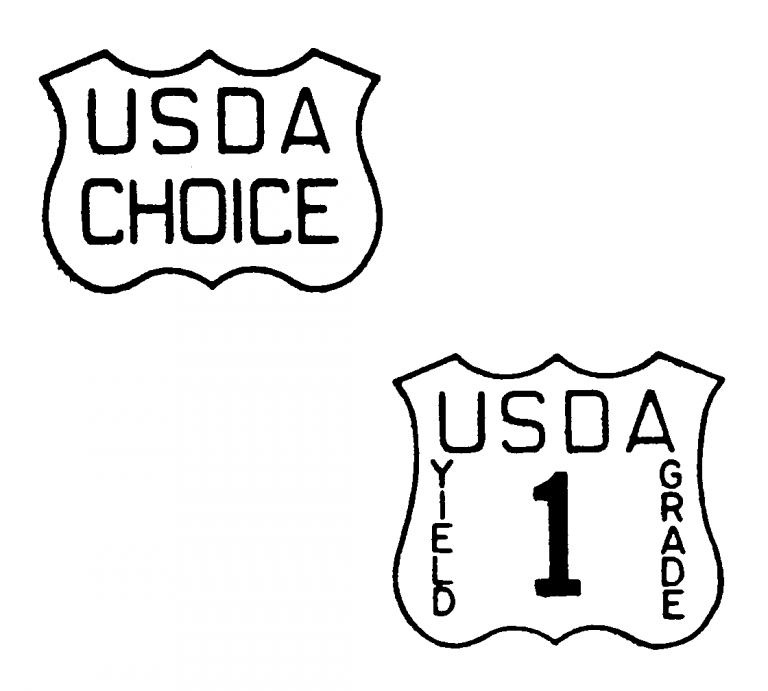
Beef and lamb grading identification labels: quality grade label (peak left); yield grade characterization (bottom correct).
Summary
Recollect that there is a deviation betwixt inspection and grading. Inspection is mandatory on meat products that are for sale to the public and may be conducted past the Country Department of Agronomics or the U.Southward. Section of Agronomics. Grading is a voluntary program that segregates meat products on the ground of their expected palatability or yield attributes. The service is provided by the U.S. Department of Agronomics.
Frederick Thousand. Ray
Erstwhile Animal Foods Specialist
Was this data helpful?
YESNO
Source: https://extension.okstate.edu/fact-sheets/meat-inspection-and-grading.html

Post a Comment for "Accompanies Beef Grading Quality Worksheet Answers"