Upload to Amazon S3 Using Visual Basic 2017
AWS Step-by-Step
Accessing Amazon S3 Buckets Through Visual Studio, Role ii
Now that you've laid the groundwork for linking Visual Studio to AWS, it'south time to begin putting together the various pieces to access S3.

In Role 1 of this serial, I began showing you lot what was necessary for linking Visual Studio to Amazon Spider web Services (AWS) for the purpose of accessing the Elementary Storage Service (S3).
Now that we have laid the groundwork, it's time to begin putting together the various pieces.
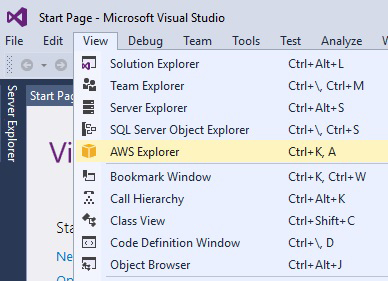
The first stride in doing and so is to connect Visual Studio to AWS past using the keys that I showed you how to learn in Part one. To become started, open Visual Studio and select the AWS Explorer pick from the View carte du jour, as shown in Figure 1 below. If the AWS Explorer option does not exist on the View bill of fare, it means that the AWS Toolkit for Visual Studio did not install correctly, and that you should completely remove information technology and re-attempt the installation.
The next thing that you will demand to practice is to link your AWS access key and secret admission key to a profile inside Visual Studio. If y'all wait in the upper-left portion of the screen, yous volition run into a Profile field. Perhaps information technology'southward just me, simply I had a hard fourth dimension locating this field the offset time that I used it. It is located below the toolbar and higher up the console tree, just below a yellow banner that says AWS Explorer. You tin see the Profile field in Figure 2.
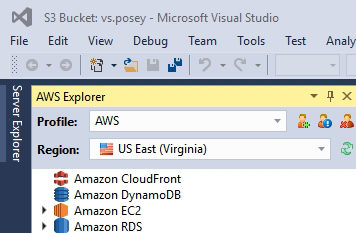
As you can see in the effigy above, there are three icons located just to the correct of the contour field. The leftmost of these icons is the New Business relationship Profile icon. Click on this icon, and Visual Studio volition open up the New Business relationship Profile dialog box, which you can run into in Figure 3.
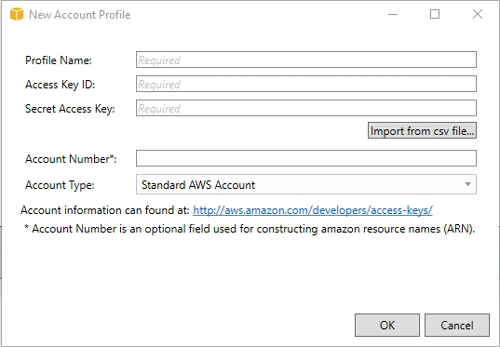
Every bit you can see in the figure above, filling in this dialog box is a relatively straightforward process. The first thing that you lot will demand to provide is a unique name for the profile. If you look back at Figure two, you can come across that I named my Profile AWS. Yous can, of class, call the profile anything that you want.
Next, you will demand to provide your Access Cardinal ID and your Underground Access Key. As you can see in the figure, you take the choice of typing or pasting these values into the dialog box, but in that location is as well an option to import the values from a .CSV file. Every bit yous may recall from the offset installment, AWS gives you the option to export these values to a .CSV file when you create an IAM account. Therefore, yous can generate the .CSV file at the time of account creation and use that aforementioned .CSV file within Visual Studio.
Finally, you will need to provide an account number. The account number is your AWS subscription number. Yous will besides demand to specify your account type before clicking OK.
At this signal, yous are just nigh ready to access your S3 buckets through Visual Studio. In fact, you may already exist able to. However, you volition need to make sure that your IAM business relationship has the required permissions. At a minimum, the IAM business relationship must take the following permissions:
S3:GetBucketAcl S3:GetBucket S3:ListBucket
You can set the required permissions past logging in to the AWS Console and going to the IAM dashboard, and then going to the Policies department. A comprehensive discussion of IAM policies is beyond the scope of this article, but I wrote a full commodity on the subject a few weeks ago called "Creating Policies for Amazon S3 Storage Buckets."
Once the permissions have been put into place, y'all should be able to admission your S3 storage buckets through Visual Studio and AWS Explorer.
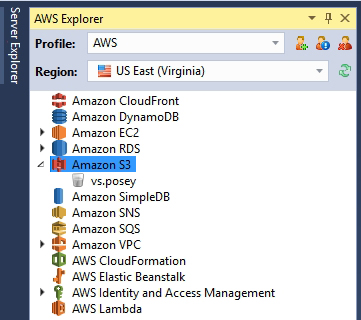
If you look at Figure 4, you tin can run into that the console tree contains an S3 container. Y'all tin can besides see that I have expanded this container to reveal a storage bucket named VS Posey. When selected, Visual Studio provides icons for uploading files and folders, and for creating folders.
About the Writer
Brien Posey is a xx-fourth dimension Microsoft MVP with decades of IT experience. As a freelance author, Posey has written thousands of articles and contributed to several dozen books on a wide multifariousness of IT topics. Prior to going freelance, Posey was a CIO for a national chain of hospitals and health care facilities. He has besides served as a network administrator for some of the state's largest insurance companies and for the Department of Defense force at Fort Knox. In addition to his continued work in IT, Posey has spent the last several years actively preparation as a commercial scientist-astronaut candidate in grooming to fly on a mission to study polar mesospheric clouds from space. Yous can follow his spaceflight preparation on his Web site.
Source: https://awsinsider.net/articles/2017/05/30/accessing-s3-through-vs-2.aspx

Post a Comment for "Upload to Amazon S3 Using Visual Basic 2017"