Commentary: How many people need to get a COVID-19 vaccine in order to stop the coronavirus?
STORRS, Connecticut: It has been clear for a while that, at least in the US, the only way out of the coronavirus pandemic will be through vaccination.
The rapid deployment of coronavirus vaccines is underway, but how many people demand to exist vaccinated in order to command this pandemic?
My approximate is that for the entire The states, roughly lxx per cent of the population needs to be vaccinated to cease the pandemic.
But variation in how people deport in different parts of the land, too equally open up questions on whether the vaccine prevents infection entirely or just prevents people from getting sick, add a degree of uncertainty.
READ: PM Lee Hsien Loong receives first dose of Pfizer-BioNTech COVID-19 vaccine
READ: Commentary: A vaccine is on the horizon. But most Singaporeans are adopting a wait-and-meet attitude
Cutting OFF Transmission
Clinical trials accept shown that one time a person gets vaccinated for the coronavirus, they won't go sick with COVID-19.
A person who doesn't get sick can still be infected with the coronavirus. But allow's also assume that a vaccinated person tin can't spread the virus to others, though researchers still don't know if this is truthful.
When enough of the population is vaccinated, the virus has a difficult fourth dimension finding new people to infect, and the epidemic starts dying out. And not everyone needs to be vaccinated, just enough people to terminate the virus from spreading out of control.
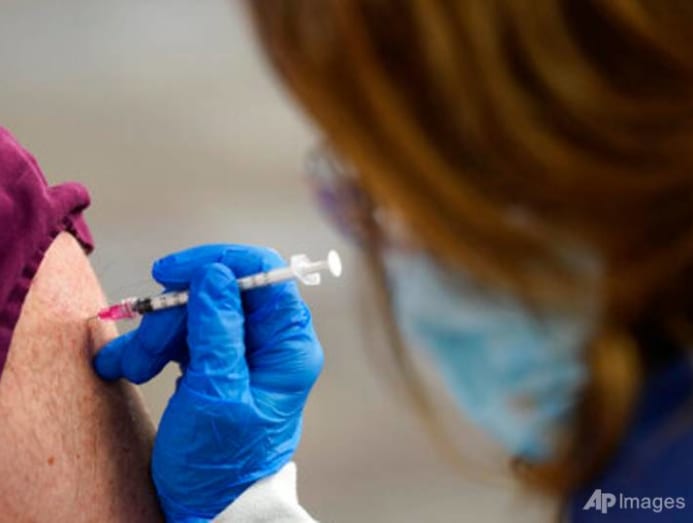
The number of people who need to be vaccinated is known as the critical vaccination level. Once a population reaches that number, you go herd immunity.
Herd amnesty is when there are so many vaccinated people that an infected person tin can hardly find anyone who could get infected, and so the virus cannot propagate to other people.
This is very of import to protect people who cannot go vaccinated.
The disquisitional vaccination level depends on how infectious the disease is and how effective the vaccine is. Infectiousness is measured using the basic reproduction number – R0 – which is how many people an infected person would spread the virus to on average if no protective measures were in place.
The more infectious a disease is, the larger the number of people who need to be vaccinated to reach heard amnesty. The higher the effectiveness of the vaccine, the fewer people need to be vaccinated.
READ: No corners cut in Singapore'south COVID-19 vaccine rollout: Expert panel doctor
READ: Experts answer FAQs on COVID-19 vaccination
NOT THE Aforementioned ANYWHERE
R0 values differ from identify to identify because their populations deport differently – social interactions are not the aforementioned in rural and urban locations, nor in warm regions compared to cold ones, for example.
Using the data on positive cases, hospitalisations and deaths, my model estimates that Connecticut currently has an R0 of two.88, meaning that, on average, every infected person would pass the virus on to 2.88 other people if no mitigation measures were in place.
Estimates at the county level range from 1.44 in rural Alpine, California to 4.31 in urban Hudson, New Jersey.
But finding an R0 value for the entire US is especially tricky because of the multifariousness of regions and because the virus has affected different areas at different times – behaviour has been far from uniform.
Estimates vary from ii.47 to eight.ii, though most researchers identify R0 for the entire US around 3.
READ: Commentary: Tin can Singapore be a major COVID-19 vaccine transshipment hub and save its aviation industry?
While R0 varies by location and betwixt estimates, the effectiveness of the vaccines is abiding and well known. The Pfizer-BioNTech and Moderna vaccines are 95 per cent and 94.five per cent effective at preventing COVID-19, respectively.
Using values for vaccine effectiveness and the R0, we tin can summate the critical vaccination level.
For the entire US, with R0 of 3, this would be 70 per cent.
In New York City, with an estimated R0 of 4.26 this would be 80 per cent.

A LOT OF Dubiousness
While the math is relatively simple, things get complicated when you consider important questions for which epidemiologists yet have no answers.
Showtime, the formula for critical vaccination level assumes that people collaborate randomly. But in the real earth, people collaborate in highly structured networks depending on work, travel and social connections.
When those contact patterns are considered, some researchers establish critical vaccination levels to be considerably smaller compared to assuming random interactions.
Unfortunately, other unknowns could take an opposite outcome.
Vaccine trials clearly prove that vaccinated people don't get ill with COVID-nineteen. Just it is still unknown whether the vaccines prevent people from getting balmy infections that they could laissez passer on to others.
READ: Commentary: Hither'due south why taking the vaccine is necessary even if it'south optional
If vaccinated people can still be infected and pass on the virus, then vaccination will not provide herd immunity – though information technology would even so forestall serious illness and reduce bloodshed drastically.
A final question that remains to be answered is how long immunity to the coronavirus lasts after a person is vaccinated. If amnesty wanes after a few months, then each individual will need repeated vaccinations.
It is hard to say with certainty how many people need to be vaccinated in order to end this pandemic. But even and so, the arrival of COVID-19 vaccines has been the best news in 2020.
In 2021, as a large proportion of individuals in the Usa go the vaccine, the country will be heading toward the critical vaccination level – whatever it may be – and then that life can beginning to return to normal.
Listen to the behind-the-scenes considerations and discussions going into what might be Singapore'south biggest vaccination programme e'er:
BOOKMARK THIS: Our comprehensive coverage of the coronavirus outbreak and its developments
Download our app or subscribe to our Telegram aqueduct for the latest updates on the coronavirus outbreak: https://cna.asia/telegram
Pedro Mendes is Professor of Cell Biology, University of Connecticut. This commentary first appeared in The Conversation.
Source: https://cnalifestyle.channelnewsasia.com/commentary/commentary-how-many-people-need-get-covid-19-vaccine-order-stop-coronavirus-283871

Post a Comment for "Commentary: How many people need to get a COVID-19 vaccine in order to stop the coronavirus?"